Partner programme
A partner programme page that publishes the rate card, the tier thresholds and a commission calculator before asking anyone to apply.
Opens in a new tab. It is a real page, not a picture of one — resize it, tab through it, run it through Lighthouse.
The brief
Self-directed. The brief is the headline: the margin, before the meeting.
Partner programme pages almost always say the same thing: grow with us, unlock rewards, apply today. The actual economics — what a partner earns and what they have to do to earn it — arrive in a call after the application, which means every serious partner has to apply just to find out whether it is worth applying.
The brief was to put the commercials first: a rate card, published tier thresholds, payment terms, and a calculator that turns a partner’s own numbers into a figure.
The calculator is the hero
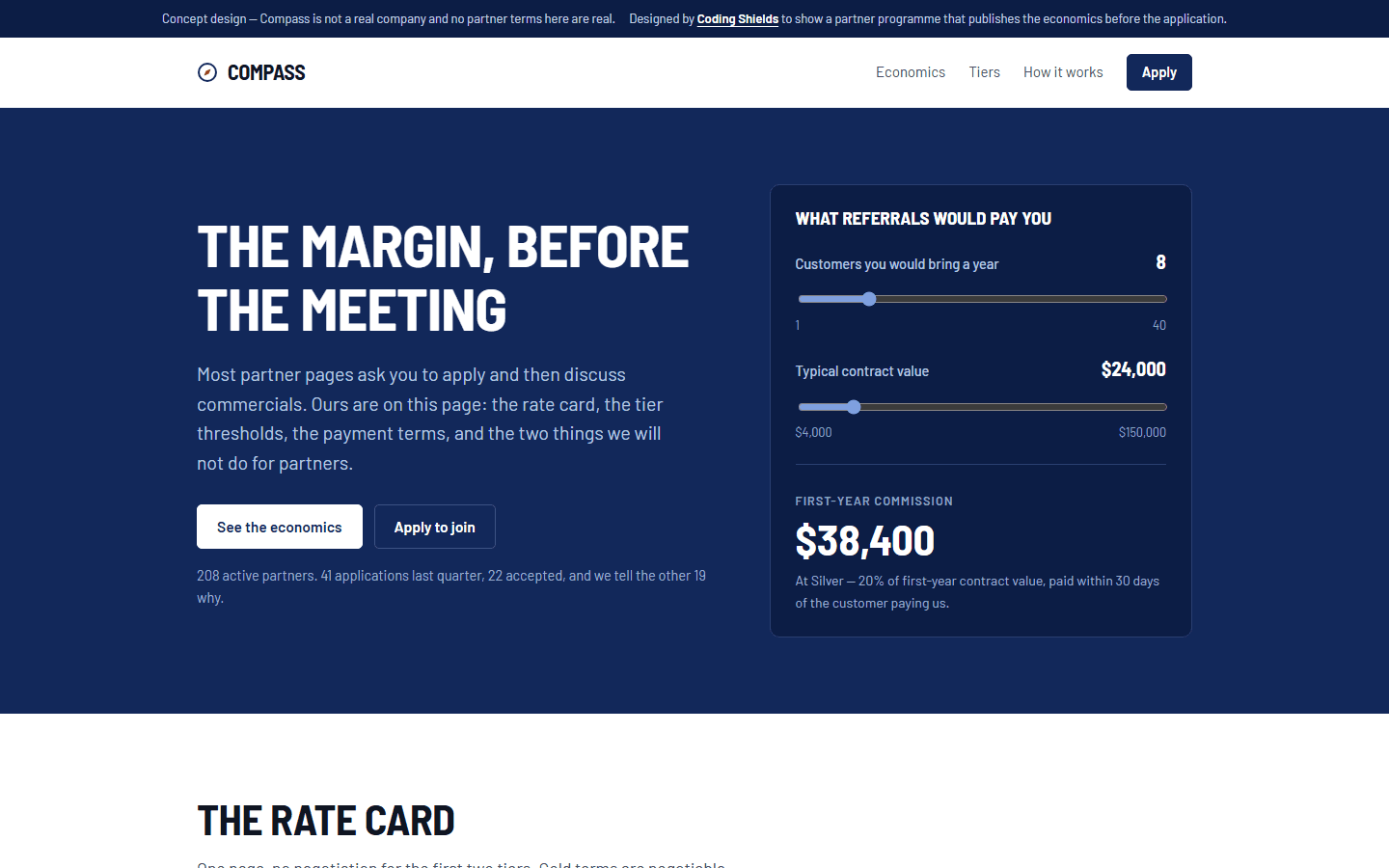
Two sliders — customers a year and typical contract value — and one output: first-year commission, with the tier it would be earned at and when it would be paid.
A partner manager evaluating a vendor has one question, and it is arithmetic. Answering it in the first screen is the difference between a page that is read and a page that is filed.
Correcting what the calculator promised
The first version paid 28% as soon as the inputs crossed $500,000. But Gold is by invitation and needs four certified staff, and the code carried a comment claiming the calculator “cannot promise a rate the rate card would not honour”. It was doing exactly that. The page also never said how the tier rates related to the separate rate card for referral, reseller and managed partners.
The calculator now stops at Silver and, at Gold volumes, says the partner would be invited to discuss Gold rather than pricing it. The tiers are stated to set the referral rate, and the rate card’s referral column says the rate rises with tier. The two tables now describe one scheme instead of two.
The two things the company will not do
Under the rate card, a panel with two commitments: the company’s own sales team will not take a registered deal from a partner, and a registration that clashes with an existing opportunity will be flagged within a business day rather than at invoice time.
These are the two disputes that end partner relationships. Stating them before the application tells a partner more about the programme than the rate does.
Decisions
Four choices that shaped the page, each with the reason attached. A decision without a reason is a preference.
01
The calculator uses the published thresholds
Bronze and Silver are computed from the same four-customers-or-$120,000 rule printed in the tier cards. If one changed without the other, the page would contradict itself in public.
02
Condensed capitals for headings, plain Barlow for reading
Barlow Semi Condensed in uppercase for headings and table heads, Barlow for everything else. It reads as a trade document rather than a consumer landing page, which is the register a partner manager is working in.
03
Tabular figures wherever money appears
The calculator output, the rate card and the slider readouts use tabular numerals, so figures do not shift sideways as a slider moves and columns of percentages line up.
04
The acceptance rate is on the page
The hero states last quarter’s applications, acceptances and declines, and that declined applicants are told why. It sets expectations before the form, which saves both sides a wasted application.
- Page weight
- 25KB of HTML, no images
- JavaScript
- One inline script: the calculator
- Typefaces
- Barlow, Barlow Semi Condensed
- Palette
- #12285A navy, #8A6300 gold
- Published
- Rate card, thresholds, payment terms
- Contrast
- Twenty-three pairs audited, AA or better
What this is not
- It is a concept. Compass is not a company and none of the partner terms are real; the rates are plausible, not researched.
- The calculator covers referral commission only. Reseller partners keep a margin and managed partners have their own rate, and a real page would need to model those too.
- There is no application form, partner directory or portal behind the buttons — the page stops at the decision to apply.
Want one of these, for real?
Every page in this section started as a blank file. Yours would start as a conversation about what it actually has to do.