Research report
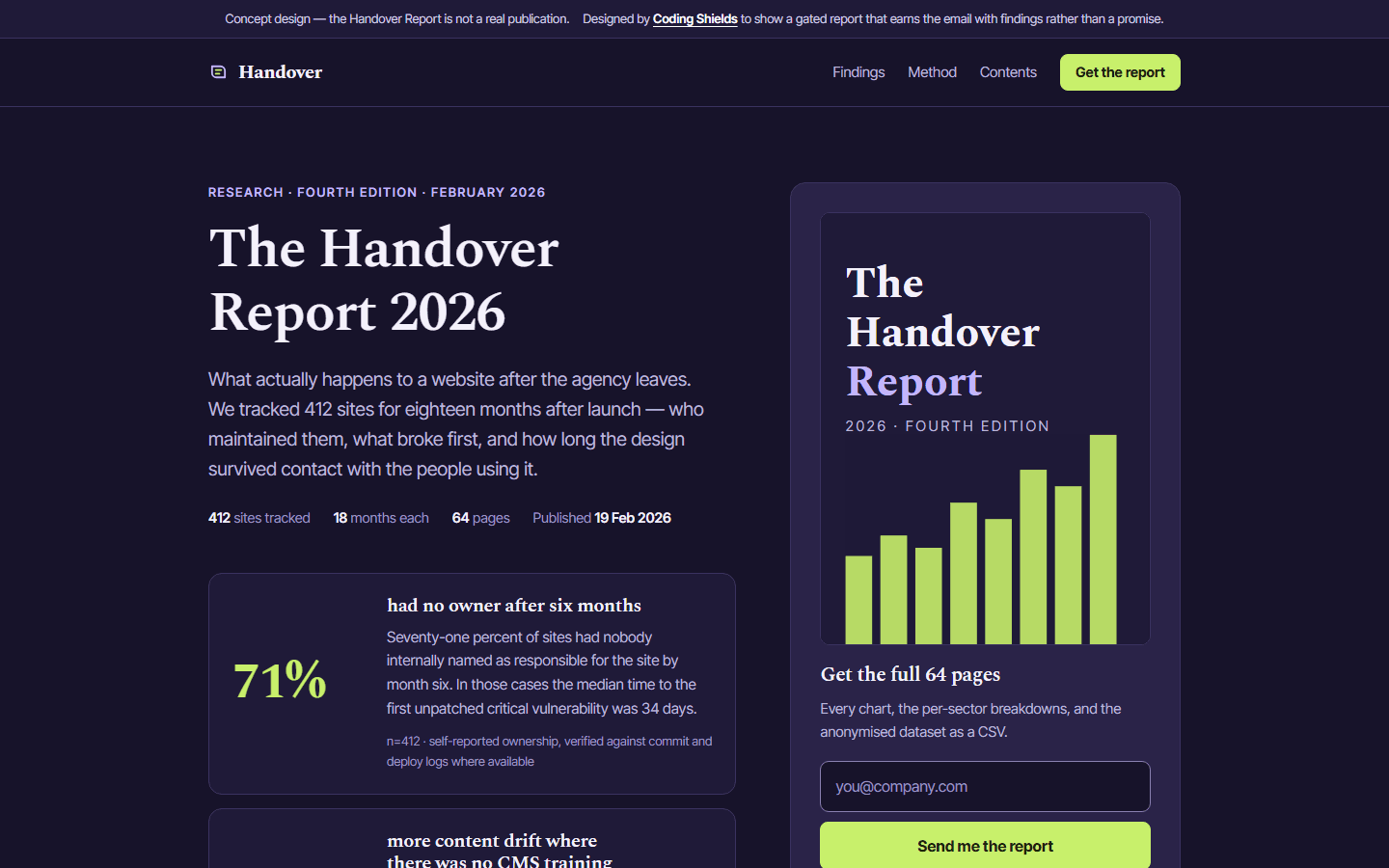
A landing page for a research report that gives away the three headline findings and the method before asking for an email.
Opens in a new tab. It is a real page, not a picture of one — resize it, tab through it, run it through Lighthouse.
The brief
Self-directed. The rule: the page has to be worth reading even if nobody downloads.
The standard gated report page promises insight and withholds all of it: a cover image, three vague bullets and an email field. The reader is asked to pay before they can judge whether the goods are worth anything, so the people who do hand over an address are mostly the ones who were never going to read it.
The brief was to reverse that. Publish the headline findings, the sample, the method and the reasons to distrust it on the page itself, and let the email be the price of the full detail rather than of finding out what the report says.
The findings, in the hero
Three findings sit directly under the headline, each with a large figure, a sentence of interpretation, and a source line giving the sample size and how the measure was taken.
The source line is the part most reports leave out of their landing page. A finding without its n is a slogan; with it, the reader can decide in five seconds whether the number applies to them.
Three reasons to distrust it
Beside the method table is a column headed “Three reasons to distrust this”: the sample is volunteered, ownership is partly self-reported, and the publisher builds websites and so benefits from the conclusion.
The third one is the important one. Declaring the conflict of interest before the download is what makes the other findings believable, because it shows the authors know how the report could be wrong.
Two claims the page got wrong about itself
The contents section said the three findings were chapters two, four and five. Counting the list beneath it, they are one, three and four. The download panel also promised a separate, unticked box for the quarterly note — and there was no such box on the page.
Both are fixed: the chapter numbers now match the list, and the panel says the research note is a separate sign-up that nothing on the page opts you into. On a page asking to be trusted about a sixty-four page document, it cannot misdescribe its own contents list.
Decisions
Four choices that shaped the page, each with the reason attached. A decision without a reason is a preference.
01
One field, and a way round it
The download form asks for an email and nothing else. Beneath it, a line points out that the findings, method and contents are already on the page, and offers a person-sent copy for anyone who would rather not use the form.
02
The panel stays in view
On wide screens the download panel is sticky, so the offer is beside the reader as they work through the findings. On narrow screens it drops back into the flow rather than covering the content.
03
Spectral for the report, Inter Tight for the page
Headings and the large figures are set in Spectral, the typeface the report itself would be set in. The interface is Inter Tight. The page previews the document’s voice as well as its content.
04
Lime on violet, for the numbers only
The lime accent carries the headline figures and the download button; lilac carries labels and links. Keeping the brightest colour for the findings means the eye goes to the evidence first.
- Page weight
- 18KB of HTML, no images
- JavaScript
- One inline script, for the form
- Typefaces
- Spectral, Inter Tight
- Palette
- #17132A ground, #C8F06B figures
- Given away
- Findings, method, caveats, contents
- Contrast
- Sixteen pairs audited, AA or better
What this is not
- It is a concept. The Handover Report does not exist; the sample, the findings and every figure in them are invented.
- The form validates the address and confirms that nothing was sent, but there is no delivery — the part that decides whether the promise of “one email, containing the PDF” is kept.
- The page presents findings responsibly, but it cannot make invented research sound. A real version would need the dataset it says it releases, and someone outside the company to check it.
Want one of these, for real?
Every page in this section started as a blank file. Yours would start as a conversation about what it actually has to do.