Newsletter and archive
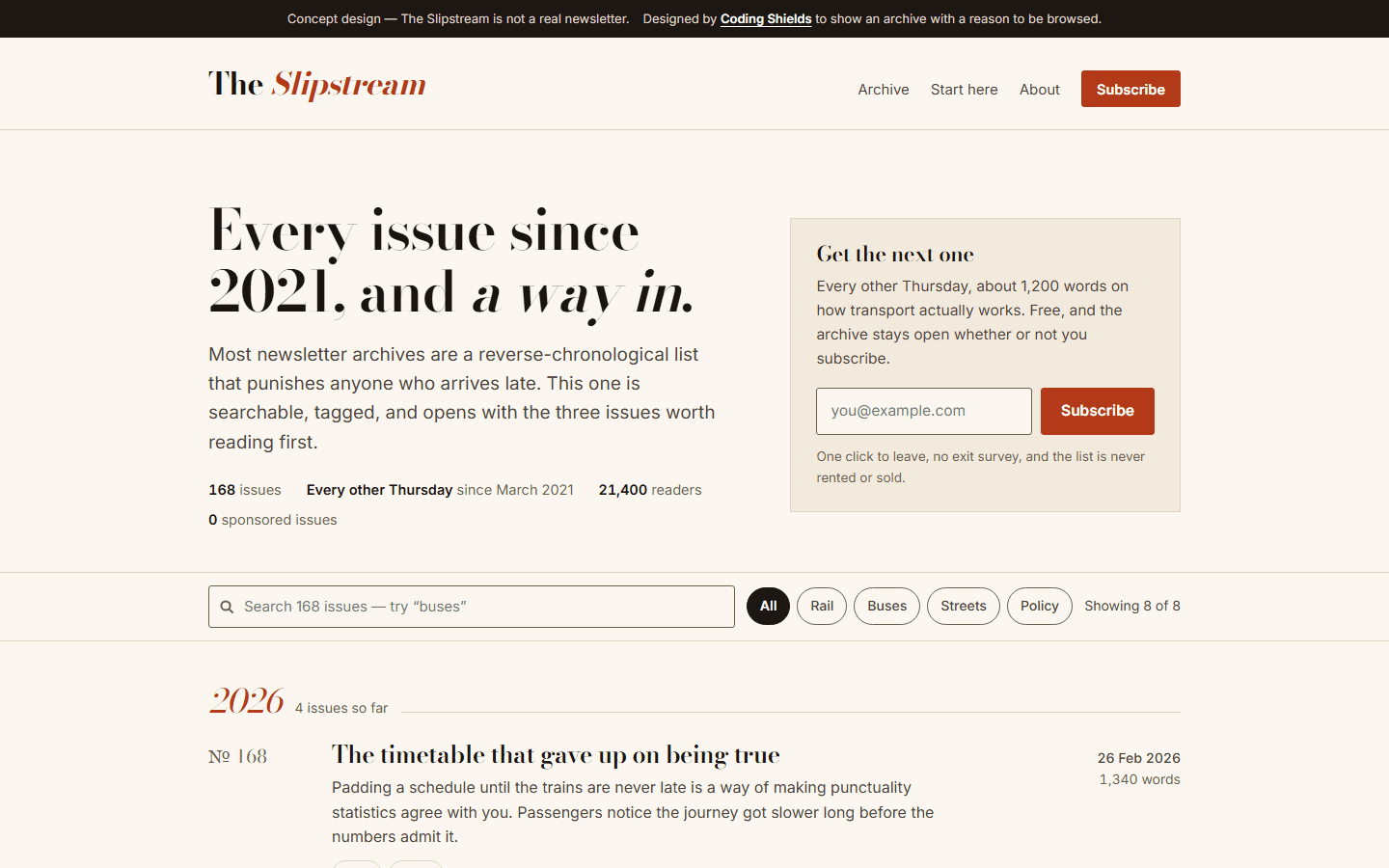
An archive for a transport newsletter that gives a late arrival a way in: search, topic filters, issues grouped by year, and a start-here set.
Opens in a new tab. It is a real page, not a picture of one — resize it, tab through it, run it through Lighthouse.
The brief
Self-directed. The brief came from how newsletter archives treat anyone who subscribes late.
Most newsletter archives are a reverse-chronological list with no search, which is a design that punishes anyone who arrives late. Four years of writing sits behind a single “older posts” link, and the best issue the author ever wrote is on page nine.
The brief was to make the back catalogue worth browsing: findable by topic and by word, grouped so the reader knows where they are in time, and opened with a short set of issues that make the rest make sense.
An issue is a headline, a standfirst and its length
Each row carries the issue number, a headline, a two-sentence standfirst, topic tags, the date and the word count. The standfirst is the argument, not a teaser: “Padding a schedule until the trains are never late is a way of making punctuality statistics agree with you.”
The word count is there because it is how people decide whether to read now or later. A 2,050-word issue and a 1,190-word issue are different commitments, and the reader should know which one they are opening.
Start here, in order
Three issues, numbered, with a note on why each one is on the list and how long the set takes. They come from 2021, 2022 and 2023, because the ideas a newsletter keeps returning to were usually argued properly once, early on.
A new subscriber’s first question is “where do I begin?”, and an archive that answers it earns the next three years of reading. A chronological list answers “what was published last?”, which is a question nobody arriving late is asking.
Fixing a search that failed its own example
The search box suggests trying “buses”. When I tested it while writing this, it returned nothing — the search only read a hidden keyword list and the headline, and none of those said “buses”. The first thing the page invited a reader to do was the thing that did not work.
Search now reads the whole row, tags and standfirst included, and “buses” finds the two bus issues. The same pass corrected the start-here section, which promised four issues and showed three.
Decisions
Four choices that shaped the page, each with the reason attached. A decision without a reason is a preference.
01
Empty years disappear with their issues
Filter to Rail and the 2026 heading only stays if a rail issue sits under it. A year heading with nothing below it looks like a bug, and it pushes the results further down the screen.
02
Results are counted out loud
The “Showing 2 of 8” line is a polite live region, so a screen reader user hears the effect of typing in the search box without having to go looking for it.
03
Bodoni for headlines, Inter for everything else
A high-contrast Didone gives the archive the feel of a publication rather than a feed. It is kept to headline sizes, where its hairlines survive; the standfirsts and interface are set in Inter.
04
The subscribe box promises the archive stays open
The form sits beside the masthead with one field, and the line above it says the archive is free whether or not you subscribe. Gating the back catalogue is the usual move, and it is the one that makes an archive useless as a reason to join.
- Page weight
- 21KB of HTML, no images
- JavaScript
- One file: search, filters, subscribe check
- Typefaces
- Bodoni Moda, Inter
- Palette
- #FBF7F0 ground, #B33A18 flame, #1C1713 deep
- Search
- Whole row: headline, standfirst, tags
- Contrast
- Fourteen pairs audited, AA or better
What this is not
- It is a concept. The Slipstream, its readership and every issue are invented.
- The page describes 130 issues and holds eight, labelled as a sample by year. Search runs in the browser over those eight; a real archive would need a proper search index behind it.
- The subscribe form checks the address and says plainly that nothing was sent; it does not submit anywhere.
Want one of these, for real?
Every page in this section started as a blank file. Yours would start as a conversation about what it actually has to do.