Product launch page
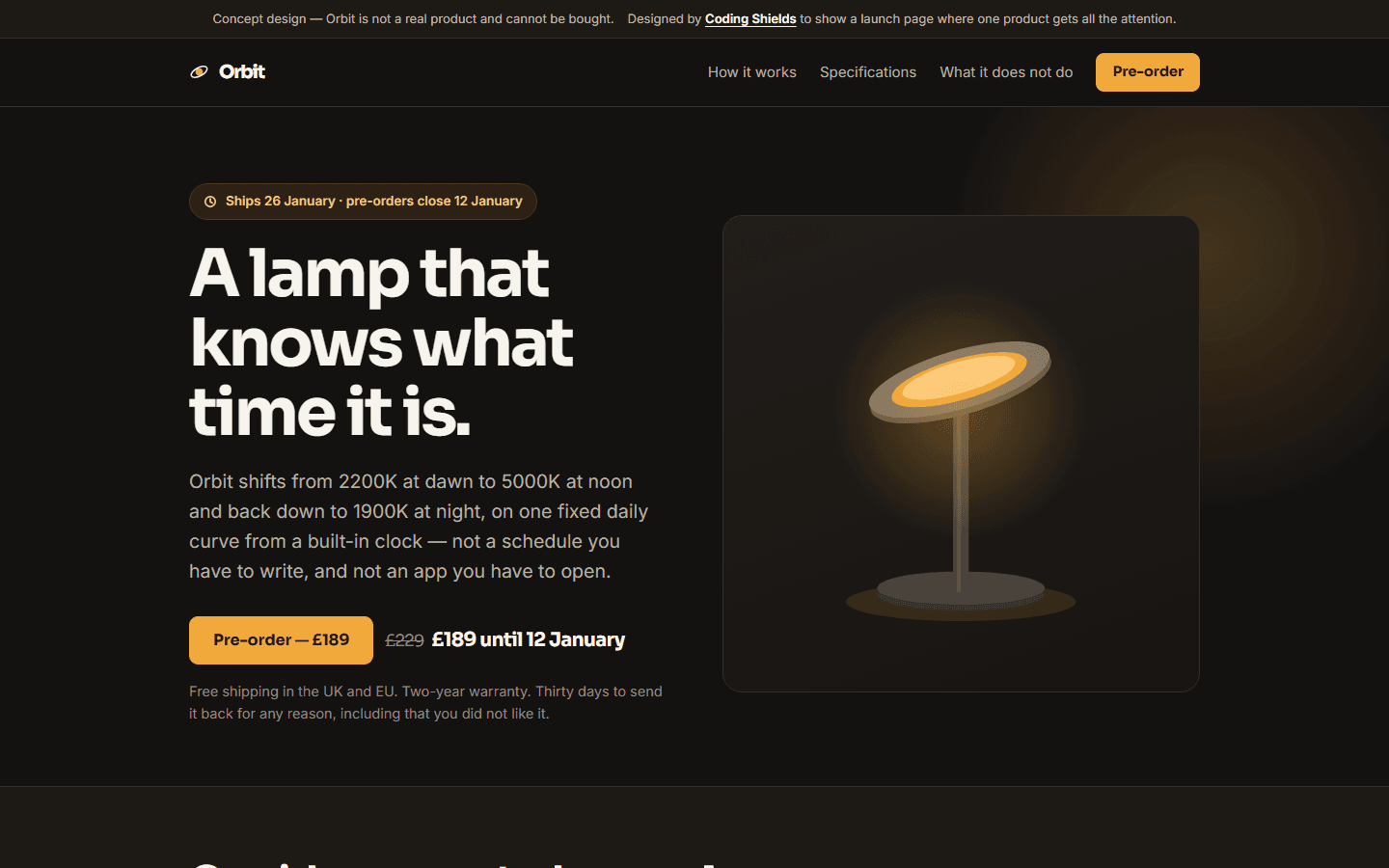
A launch page for a single desk lamp, built around one idea and a section listing what the product will not do.
Opens in a new tab. It is a real page, not a picture of one — resize it, tab through it, run it through Lighthouse.
The brief
Self-directed. No client — the product, the price and the constraints are mine.
Launch pages for physical products tend to fail the same way: every feature gets equal billing, so the one thing the product is actually for ends up as the fourth bullet in a grid of eight. The reader leaves knowing it has USB-C and not knowing why they would want it.
The brief I set was a lamp with one genuine idea — colour temperature that follows the time of day — and a page that gives that idea the whole middle of the screen, then answers the objections before anyone has to ask.
One idea, drawn as a strip
The centre of the page is a band running across a day, from 2200K at six in the morning to 5000K at noon and down to 1900K at eleven at night, with the times and temperatures labelled underneath. It is the product’s whole argument in one horizontal line.
The copy around it is short on purpose. Brightness is a dial you turn and it stays where you left it — the page says that explicitly, because the fear with any “automatic” lamp is that it will second-guess you.
What Orbit does not do
Four limitations, each with a reason: it does not connect to anything, it is not cordless, it will not light a room, and it is expensive. The last one is stated as plainly as that.
A launch page that only lists strengths asks the buyer to find the weaknesses after the box is open, which is when they become returns. Naming them up front costs a few sales to the wrong people and saves the refunds.
Fixing a contradiction before writing about it
The first version of the hero said the lamp followed “the sun where you actually are”, while the specification table two sections down said it had no connectivity of any kind. A lamp with no wifi and no app cannot know where you are. It also said 2700K at dawn, where the strip said 2200K.
The hero now says the lamp runs one fixed daily curve from a built-in clock, and the dawn figure matches the strip. On a page whose selling point is candour about limits, the product copy cannot quietly claim a capability the spec table rules out.
Decisions
Four choices that shaped the page, each with the reason attached. A decision without a reason is a preference.
01
The product is drawn, not photographed
The lamp in the hero is inline SVG with a text description. There is no image file on the page, so the hero is complete on first paint and the product never arrives late behind a loading photograph.
02
Amber on warm near-black
One accent, the colour of the light the lamp makes at dusk, used for the actions, the spec figures and the product itself. The ground is a warm brown-black rather than neutral, so the page reads as lamplight rather than as a tech launch.
03
The glow breathes, and only if you allow it
A soft glow behind the lamp swells and fades on a seven-second loop. It sits inside a no-preference media query, so under a reduced-motion setting it simply does not animate. It is the only moving thing on the page.
04
Scarcity with a date that can be checked
The closing section gives the size of the first run, how many are spoken for, and when the next batch ships if it sells out. Urgency with a number attached reads as information; urgency without one reads as a countdown timer.
- Page weight
- 21KB of HTML, no images
- JavaScript
- One inline script, for the dates
- Typefaces
- Sora, Inter
- Palette
- #141210 ground, #F2A93B amber
- Motion
- One loop, off under reduced-motion
- Contrast
- Thirteen pairs audited, AA or better
What this is not
- It is a concept. Orbit does not exist, and the price, the specifications and the pre-order figures are invented.
- The 25kHz driver, the colour rendering index and the flicker figure are the product’s claims, not measurements anyone has taken. A real launch page would link to the test report behind each one.
- There is no checkout, no stock state and no sold-out version of the page — which is the version a launch page spends most of its life as.
- The ship date and the pre-order deadline are not fixed. A small script keeps them about three months ahead of whoever is reading, so the concept never advertises something that has already happened. A real page has one set of dates and has to keep them.
Want one of these, for real?
Every page in this section started as a blank file. Yours would start as a conversation about what it actually has to do.