Security and trust centre
A security and trust page written to answer an enterprise review before the questionnaire is sent.
Opens in a new tab. It is a real page, not a picture of one — resize it, tab through it, run it through Lighthouse.
The brief
Self-directed. The brief came from watching how long security reviews actually take.
Enterprise procurement extracts the same forty answers from every vendor over about six weeks of email. Both sides know the answers in advance. The delay is pure friction, and it is friction the vendor can remove unilaterally by publishing.
The brief was to write the page that ends that exchange: reports, subprocessors, retention periods, incident history, access control — and, where the answer is no, the word no.
Today, before the certificates
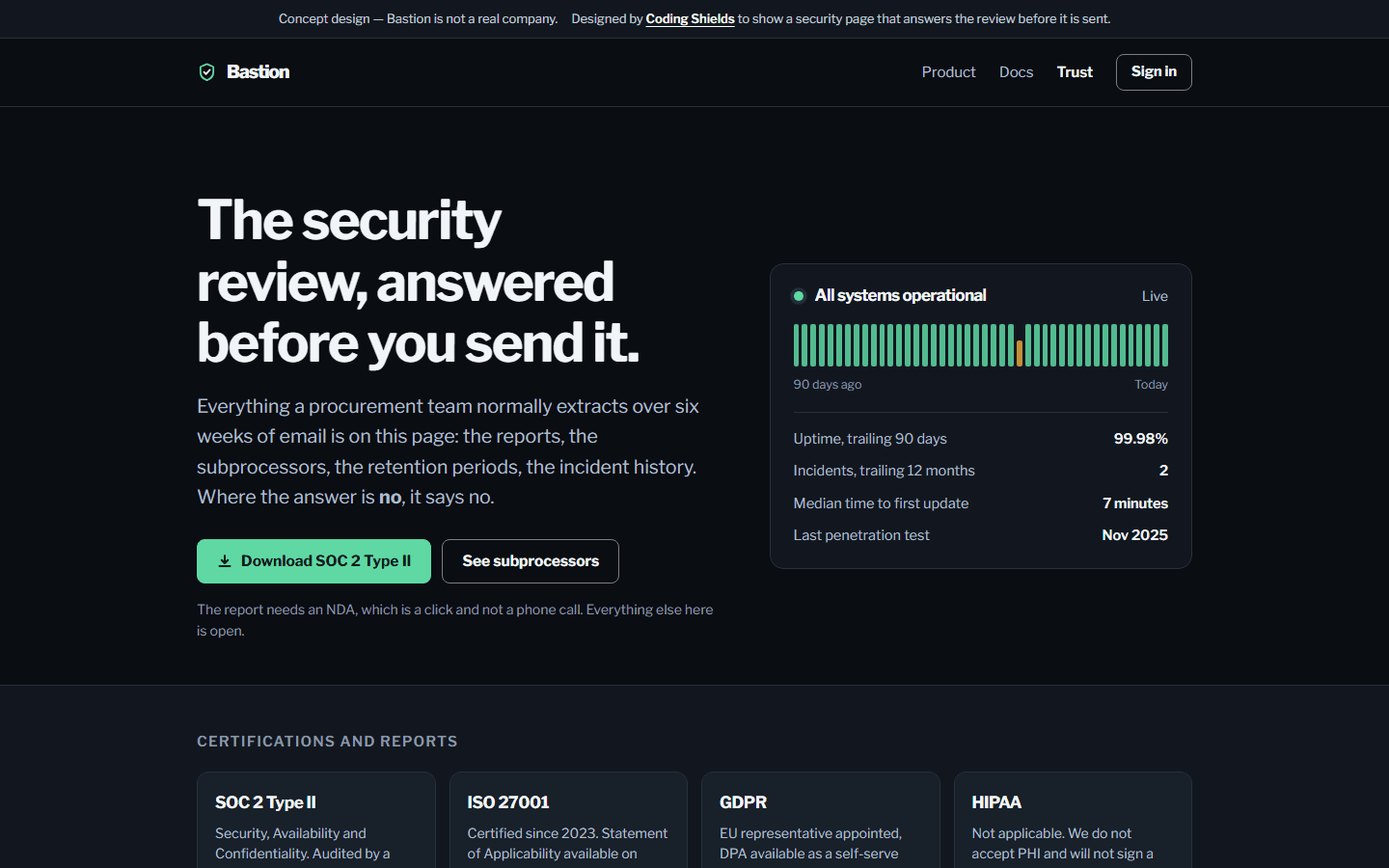
The first thing on the page is live status: ninety days of uptime, the incident count, the median time to a first update. Certifications come after.
A SOC 2 report describes a window that ended months ago. Uptime describes this morning. A reviewer wants both, and the order says which one the vendor thinks they should weigh more.
The section that makes the rest credible
There is a band headed “What we do not do”, and it rules the product out of four situations: no BAA and no PHI, no on-premise, no FedRAMP, no customer-managed keys yet.
This is the most commercially uncomfortable content on the page and the reason the rest of it is believable. A trust page that only lists capabilities is a sales page wearing a lanyard — and a reviewer who finds one omission stops trusting the other thirty-nine answers.
Incidents kept up after they stopped being useful
Two incidents in twelve months, both still linked, with durations and post-mortems. Next to them a note saying that “we have never had a breach” is worth almost nothing, because every vendor says it right up until the day they cannot.
What is worth something is a write-up published while it was still embarrassing, and the fact that the page a reviewer reads is the page the auditors read.
Decisions
Four choices that shaped the page, each with the reason attached. A decision without a reason is a preference.
01
The full subprocessor list, not the highlights
Five rows including the helpdesk, with the data each one touches and the region it sits in. The helpdesk row is the one most vendors omit, and it is the one that matters, because it is where a customer’s own attachment ends up.
02
Retention stated as ninety-one days, not thirty
Live systems purge at thirty; backups roll off at ninety. The page gives the outer bound rather than the flattering number, because a reviewer will find the difference and the finding is what costs you the deal.
03
Dark, because it is read at the end of a long day
This page is opened by someone working through a vendor list. Near-black with one mint accent keeps a dense page of tables calm, and the accent marks only the things that are actionable.
04
The NDA gate is a click, and the page says so
Only the SOC 2 report is behind anything, and the button states that the NDA is a click rather than a phone call. A gate you explain is tolerable; a gate you discover is not.
- Page weight
- 22KB of HTML, no images
- JavaScript
- One file, for the section marker
- Typeface
- Libre Franklin, one family
- Palette
- #0A0D12 ground, #5FD8A4 accent
- Contrast
- Fourteen pairs audited on a dark ground
- Structure
- Five sections, jump nav, live status
What this is not
- It is a concept. Every certification, subprocessor and incident on it is invented, which is exactly the sort of page where that needs saying at the top — and the banner does.
- The uptime strip is drawn, not fed by a status API. A real trust centre must read from the same source as the status page or it will eventually contradict it.
- It answers a security review. It does not answer legal, procurement or insurance, which arrive next and want different documents.
Want one of these, for real?
Every page in this section started as a blank file. Yours would start as a conversation about what it actually has to do.