Switch and migration page
A switch page that names the competitor, publishes the sums, and lists three reasons to stay where you are.
Opens in a new tab. It is a real page, not a picture of one — resize it, tab through it, run it through Lighthouse.
The brief
Self-directed. Both products are invented so that the comparison could be written without pulling a real company into a demo.
Competitor comparison pages are the most obviously untrustworthy documents in software marketing. Every row is ticked on one side. The reader knows the page was written by the winner, and discounts the entire thing on sight — including the rows that happen to be true.
The brief was to build one that is worth reading precisely because it loses. Publish the arithmetic, name the competitor, and put the three reasons to stay with them in a box you cannot miss.
The bill, before the argument
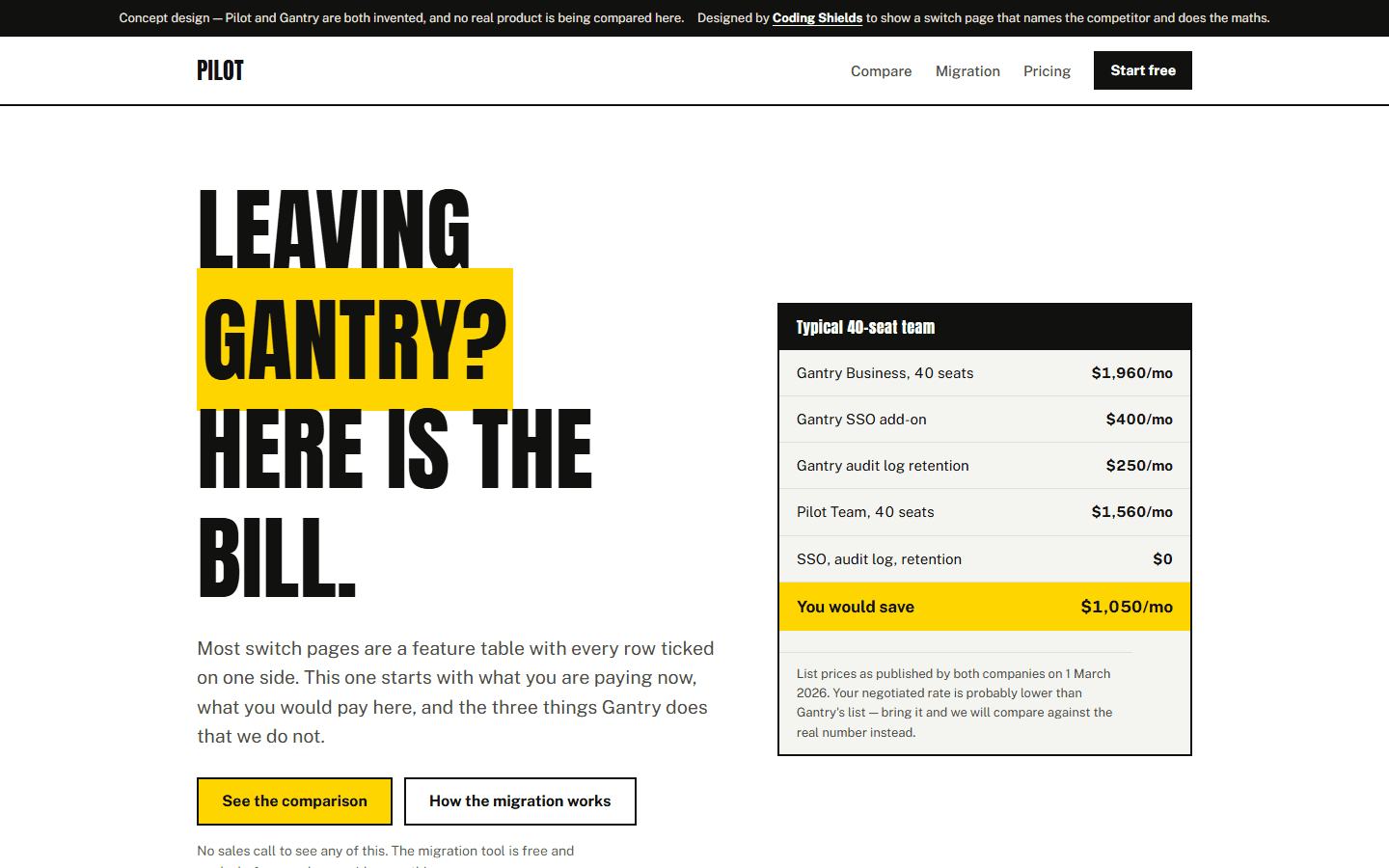
The hero holds a receipt: what a forty-seat team pays today including the add-ons, what they would pay here, and the difference. No feature talk above the fold at all.
It also says the buyer’s negotiated rate is probably lower than the competitor’s list price and invites them to bring the real number. A comparison that pre-empts its own weakest assumption is doing something the reader has not seen before.
A table with losses in it
Eight rows. Three go the other way: mobile apps, marketplace size, and on-premise deployment. Each loss is stated plainly and one of them ends with “this is a real gap for us”.
The losing rows are what make the winning rows readable. A table with no losses proves only who wrote it; a table with three proves that somebody was willing to write them down.
Three reasons to stay, in a box of their own
If your team works from phones, if you depend on a marketplace plugin, or if you need it in your own datacentre — stay. It is written as advice rather than as a hedge.
The reasoning is stated too: better to be ruled out in ten minutes than to churn in five months. That sentence is doing more sales work than any of the ticks above it.
Decisions
Four choices that shaped the page, each with the reason attached. A decision without a reason is a preference.
01
Anton and hard black rules, because the page is an argument
Condensed display type, two-pixel borders, one yellow highlight. The page is making a confrontational claim, and a soft treatment would have read as hedging.
02
The migration path admits the slow step is theirs
Step one is raising the competitor’s export ticket, which takes up to ten business days, and the page tells you to start there because everything else waits on it. Sequencing the plan around a delay you do not control is more useful than pretending it is not there.
03
Run both in parallel for two weeks, written into the plan
Not offered as reassurance — stated as a step, with the note that every team who skipped it regretted it. A migration plan that assumes a clean cutover is a plan written by someone who has not done one.
04
Green and red for wins and losses, never colour alone
Every cell carries the word as well as the colour, and the loss rows are prose rather than a cross. Colour-coded comparison tables are unreadable for a tenth of the audience if the colour is doing the work by itself.
- Page weight
- 17KB of HTML, no images
- JavaScript
- None
- Typefaces
- Anton, Public Sans
- Palette
- #FFFFFF ground, #FFD500 highlight
- Comparison
- Eight rows, three of them losses
- Contrast
- Every pair audited, AA or better
What this is not
- Both products are invented. A real version of this page carries legal risk and needs every claim dated and sourced, which is why the footer here carries a compilation date.
- The savings figure uses list pricing. Most teams of that size are not on list, and the page says so rather than quietly relying on it.
- It argues for the switch and stops. Onboarding, data mapping and the first ninety days are where a migration actually succeeds or fails, and none of that is here.
Want one of these, for real?
Every page in this section started as a blank file. Yours would start as a conversation about what it actually has to do.