Changelog and roadmap
A public changelog and roadmap for a data product, designed to prove the thing is still being built.
Opens in a new tab. It is a real page, not a picture of one — resize it, tab through it, run it through Lighthouse.
The brief
Self-directed. The question behind it: what would make a buyer believe a product is alive?
A prospect evaluating a small product asks one thing they will never put in an email: is this still being worked on? A changelog is the only honest answer to that, and most of them are written as marketing — which converts the evidence back into a claim.
The brief was to design a page that could not be faked: dated entries, named authors, breaking changes tagged as breaking, and a roadmap that includes the things the team has decided not to do.
Cadence, stated as numbers you can check
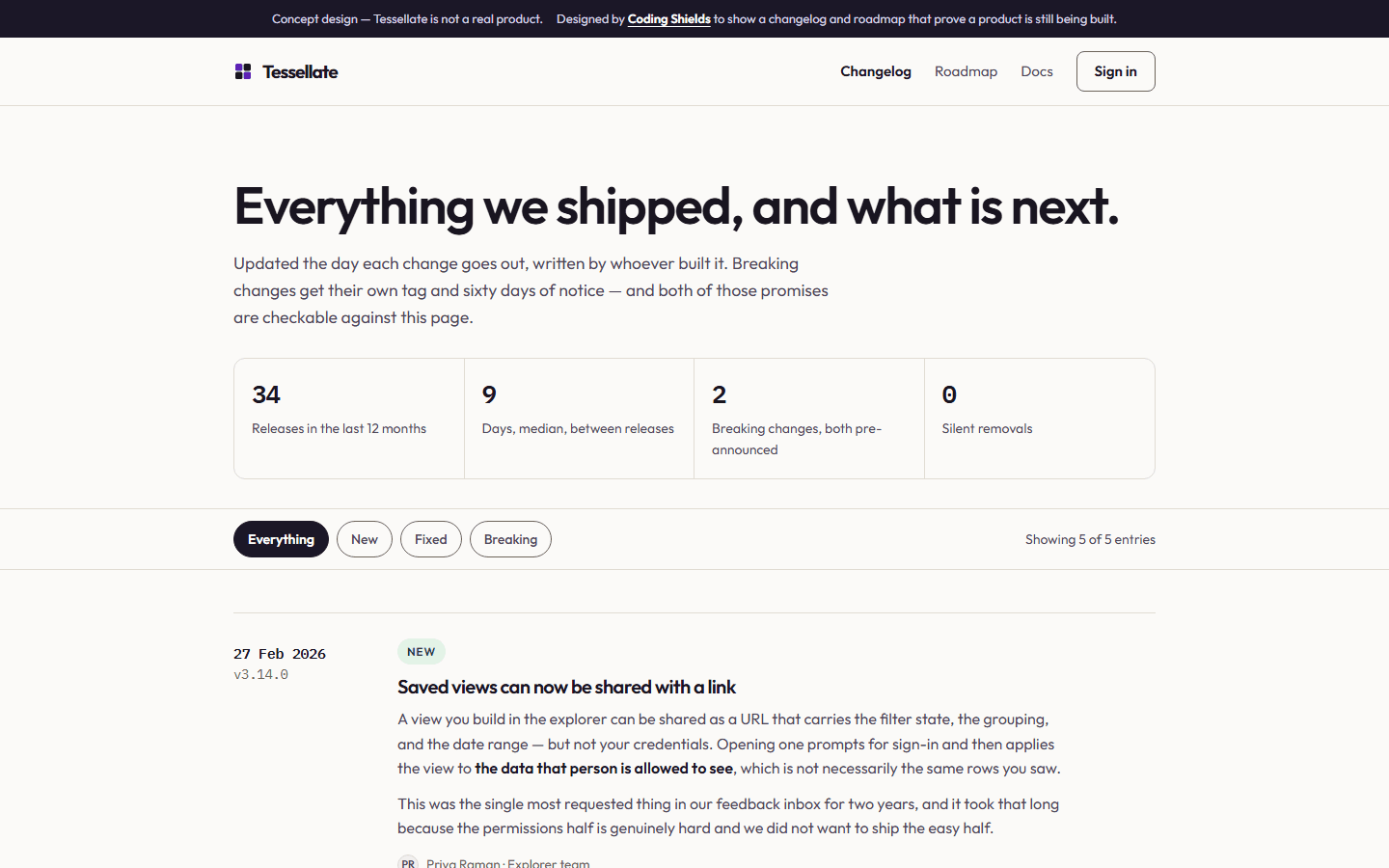
The page opens with four figures: releases in twelve months, median days between them, breaking changes, and silent removals. Every one of them is checkable against the entries below it.
That is the point. A claim you publish next to its own evidence is a different kind of claim — the reader can audit it in thirty seconds, and a vendor who invites that is telling you something before you have read a single entry.
Breaking changes get the loudest tag on the page
The breaking entry says what breaks, shows the code pattern that survives and the one that does not, states when it was announced, and gives the version header that pins the old behaviour.
It also says how many accounts were emailed. A vendor who counts the people they disrupted is a vendor who noticed, and that detail does more for trust than any amount of “we value your feedback”.
A roadmap column for the answer “no”
Three columns: building now, next up, and asked for but not planned. The third holds an on-premise request marked as declined, with the reason — supporting it properly needs a team that does not exist, and doing it badly is worse than saying no.
Roadmaps that only contain future yeses are wishlists. The declined column is what makes the other two columns mean anything.
Decisions
Four choices that shaped the page, each with the reason attached. A decision without a reason is a preference.
01
No dates beyond a quarter, and a paragraph explaining why
The page says outright that target months were tried, half were missed, and the misses cost more trust than the hits earned. A roadmap without dates looks evasive unless you say why — so it says why.
02
Every entry carries the name of who wrote it
Changelogs written by a company are press releases. Changelogs written by the engineer who shipped the change read differently, and the reader can tell within a sentence.
03
The filter matches tags, not a single kind
An entry tagged both Breaking and New appears under either filter. Forcing every entry into one bucket would hide the most important entries from the most important filter.
04
A fix entry that tells you to go and re-run something
The truncated-export bug names the affected date range and tells the reader to re-run. Most changelogs describe a fix; very few tell you that you may still be holding bad data because of it.
- Page weight
- 22KB of HTML, no images
- JavaScript
- One file, for the tag filter
- Typefaces
- Outfit, IBM Plex Mono
- Palette
- #FBFAF8 ground, #5B21B6 accent
- Contrast
- Every pair audited, AA or better
- Filter
- Announced to screen readers on change
What this is not
- It is a concept. The release history is invented, which is a slightly awkward thing to say about a page whose argument is that the history is checkable.
- Six entries are shown. A real changelog would need pagination, an RSS feed that works, and a permalink per entry.
- The roadmap has no voting, no comments and no account state. Those change the design substantially and are a different brief.
Want one of these, for real?
Every page in this section started as a blank file. Yours would start as a conversation about what it actually has to do.