Author and book launch
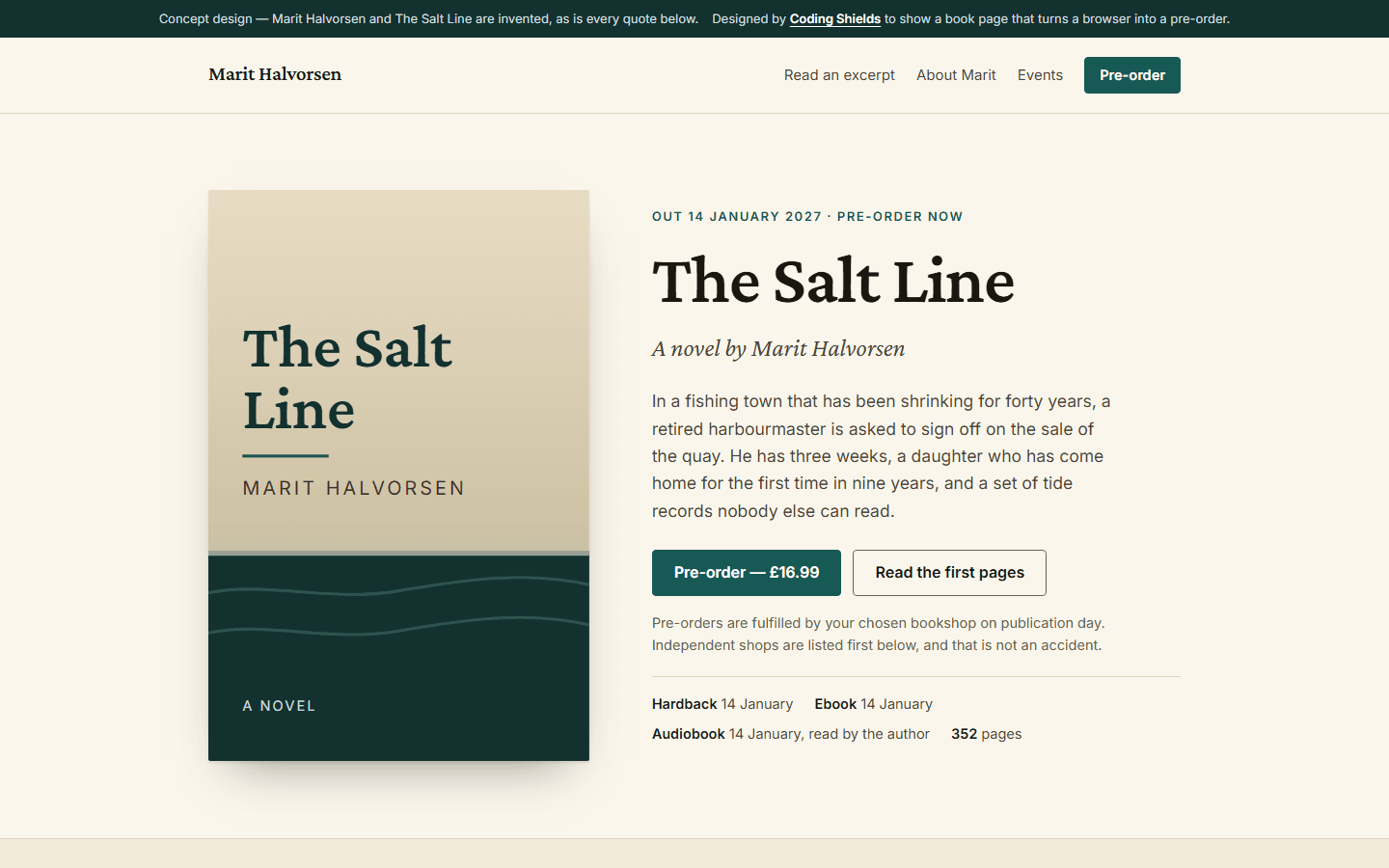
A launch page for a novel that lets the book make its own case with the real opening, then sends pre-orders to independent shops first.
Opens in a new tab. It is a real page, not a picture of one — resize it, tab through it, run it through Lighthouse.
The brief
Self-directed. The author, the novel and every quote on the page are invented.
Book launch pages tend to sell the book the way a poster does: a cover, a tagline, three one-word quotes, and a row of retailer logos with the largest one first. None of that tells a reader whether they will like the prose, which is the only thing they are really deciding.
So the brief was to let the writing do the selling — put the opening of the book on the page, not a teaser from the middle — and to treat the pre-order links as a choice the author cares about rather than a logo wall.
The opening, set like a book
The excerpt is the start of the novel, set in Crimson Pro at twenty pixels in a narrow measure with a drop cap, the way a page of the book would sit. It is introduced with a single honest line: if you do not want it after this, the page has done its job.
A sample is the strongest sales copy a novel has, and it is the only part of the page the author actually wrote for the reader rather than for the market.
Independent shops first, and saying why
The pre-order section lists an independent bookshop finder first, styled as the primary button, and the large chains after it. The hero says plainly that this order is not an accident.
It also says no email is needed to pre-order anywhere, and explains in one sentence why pre-orders matter to a book like this. A reader who understands the ask is more likely to act on it than one who is simply told to click.
Events that carry their access notes
Five dates, each with the venue, what happens, and a price or booking link on the right. Two carry access detail in the listing itself — a hearing loop and BSL interpretation at one, two steps and a level side door at another. A sold-out date stays listed and says so, rather than disappearing.
The first version of the page promised eight dates above a list of five, and described its excerpt as running to the end of the first scene while also saying it continued for eleven more pages. Both lines are corrected; a page asking to be trusted with a pre-order cannot miscount its own list.
Decisions
Four choices that shaped the page, each with the reason attached. A decision without a reason is a preference.
01
The cover is drawn, not photographed
The cover is inline SVG with its title as text, so it is sharp at any size, weighs almost nothing, and is described to a screen reader as what it shows.
02
Two actions in the hero, and one of them is reading
The primary button is the pre-order with the price on it. The secondary is “Read the first pages”. Offering the sample at the same level as the purchase is the page admitting that most people need it first.
03
Formats and dates in one line
Hardback, ebook and audiobook, each with its date, and the page count, in a single row under the actions. It answers the three questions people otherwise scroll to the footer for.
04
Nothing needs a runtime
The excerpt is text, the events are a list, and the pre-order links go to the shops. The one script on the page only moves the dates, and with it switched off the page reads exactly as written.
- Page weight
- 21KB of HTML, no image files
- JavaScript
- One inline script, for the dates
- Typefaces
- Crimson Pro, Inter
- Palette
- #FBF6EC ground, #175A55 sea green
- Excerpt
- Six paragraphs, 20px, 34rem measure
- Contrast
- Seventeen pairs audited, AA or better
What this is not
- It is a concept. Marit Halvorsen, The Salt Line, the reviews, the prize and the tour are invented.
- The excerpt is six paragraphs and stops at the end of the opening scene. A real launch page would offer a longer sample to download.
- Only two of the five events carry access notes. The page says every venue is step-free unless listed otherwise, which is a promise a real publicist would need to check venue by venue before printing.
- The publication date and the tour dates are not fixed. A small script keeps them about three months ahead of whoever is reading, so the concept never advertises something that has already happened. A real page has one set of dates and has to keep them.
Want one of these, for real?
Every page in this section started as a blank file. Yours would start as a conversation about what it actually has to do.