Case study library
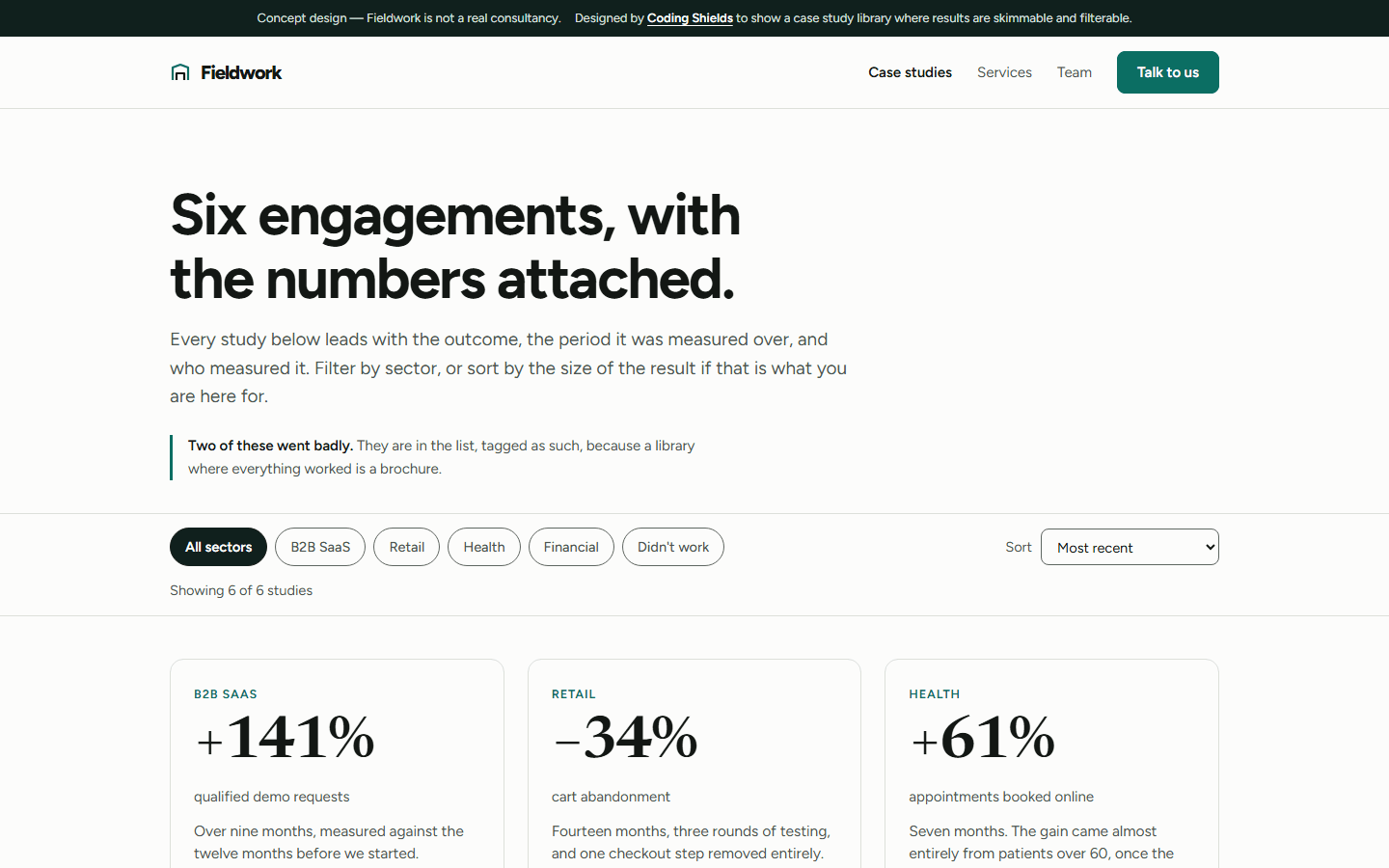
A case study library where every card leads with an outcome, the period it was measured over, and who measured it — including the two that failed.
Opens in a new tab. It is a real page, not a picture of one — resize it, tab through it, run it through Lighthouse.
The brief
Self-directed, from reading too many case study pages with a percentage and nothing else.
Most case study libraries are unfalsifiable. A large percentage, no time period, no baseline, no source, set over a stock photo of people looking at a laptop. A buyer learns that the agency is willing to publish large percentages, and nothing else.
The brief was to design the library a sceptical buyer would trust: results as the first thing on each card, the measurement terms attached to every figure, and the failures published on the same terms as the successes.
The metric leads, and it carries its terms
Each card opens with the sector, then the result set large in a serif: +141% qualified demo requests, −34% cart abandonment. Directly under it, one line saying how long the engagement ran and who produced the number.
The line under the number is the design. A figure with a period and a source attached is something a buyer can weigh; a figure without them is decoration. The page states the baseline rule once, in a method section at the foot, rather than repeating it six times.
Two of the six went badly, and they are in the list
A homepage rebuild that moved trial starts by 3%, inside the noise, because the real problem was the product’s trial limits. A project the client reverted within a quarter of a reorganisation. Both carry a “Didn’t work” tag, and there is a filter chip for exactly those.
Publishing failures sounds like a risk. In practice it is the single thing that makes the successes believable — a library where everything worked reads as a brochure, and a buyer discounts every number in it accordingly.
Checking my own page against its own rule
The first version of this page claimed that every study named who measured it. Four of the six cards did not. On a page whose argument is that unsourced numbers are worthless, that was the exact failure it was built to criticise.
Each card now names its source, and the counts agree with the method section: two measured by the client’s own team, four by the agency using the client’s data. I found it while writing this up, and it is recorded here rather than quietly patched.
Decisions
Four choices that shaped the page, each with the reason attached. A decision without a reason is a preference.
01
Sorting rearranges the markup, not just the view
Sort by result size or engagement length and the cards are moved in the document, not repositioned with CSS. The order a keyboard user tabs through is always the order a sighted user reads.
02
The count is announced
“Showing 2 of 6 studies” sits in a polite live region, so filtering is confirmed to someone who cannot see the grid change. The filter chips report their pressed state rather than relying on colour.
03
“Largest result” sorts by size, not direction
A 34% drop in abandonment is a bigger result than a 22% rise in applications, so it ranks higher. Sorting by signed value would put every reduction at the bottom, and most of the best work in conversion is a reduction.
04
A serif for the numbers only
Newsreader sets the metrics; Figtree sets everything else. The figure is the one element on each card that should read as a statement rather than as interface.
- Page weight
- 19KB of HTML, no images
- JavaScript
- One file, for filter and sort
- Typefaces
- Figtree, Newsreader
- Palette
- #FCFCFB ground, #0B6E63 teal, #10201D deep
- Measurement
- Period and source on every card
- Contrast
- Thirteen pairs audited, AA or better
What this is not
- It is a concept. Fieldwork, its clients and every result on the page are invented, and the studies the cards link to do not exist.
- Six studies is a small library. The filters and sorting are designed for it, and a library of sixty would need search and a different card density.
- Stating who measured a number is not the same as the number being right. The page makes results checkable in principle; it cannot make them true.
Want one of these, for real?
Every page in this section started as a blank file. Yours would start as a conversation about what it actually has to do.