Invoicing for small firms
Invoicing for a one-person business, designed so the money you are owed is the first thing on screen.
Opens in a new tab. It is a real page, not a picture of one — resize it, tab through it, run it through Lighthouse.
The brief
Self-directed, from watching how small firms actually use accounting software.
Accounting tools are built for accountants and sold to sole traders. The default screen is a balance sheet, a chart of accounts, or a cash-flow graph — none of which is the thing a joiner opens the app to find out. They open it to see who has not paid.
So the brief was to design the first screen around that single question and let the accounting live behind it.
Four tiles, and the first one is overdue
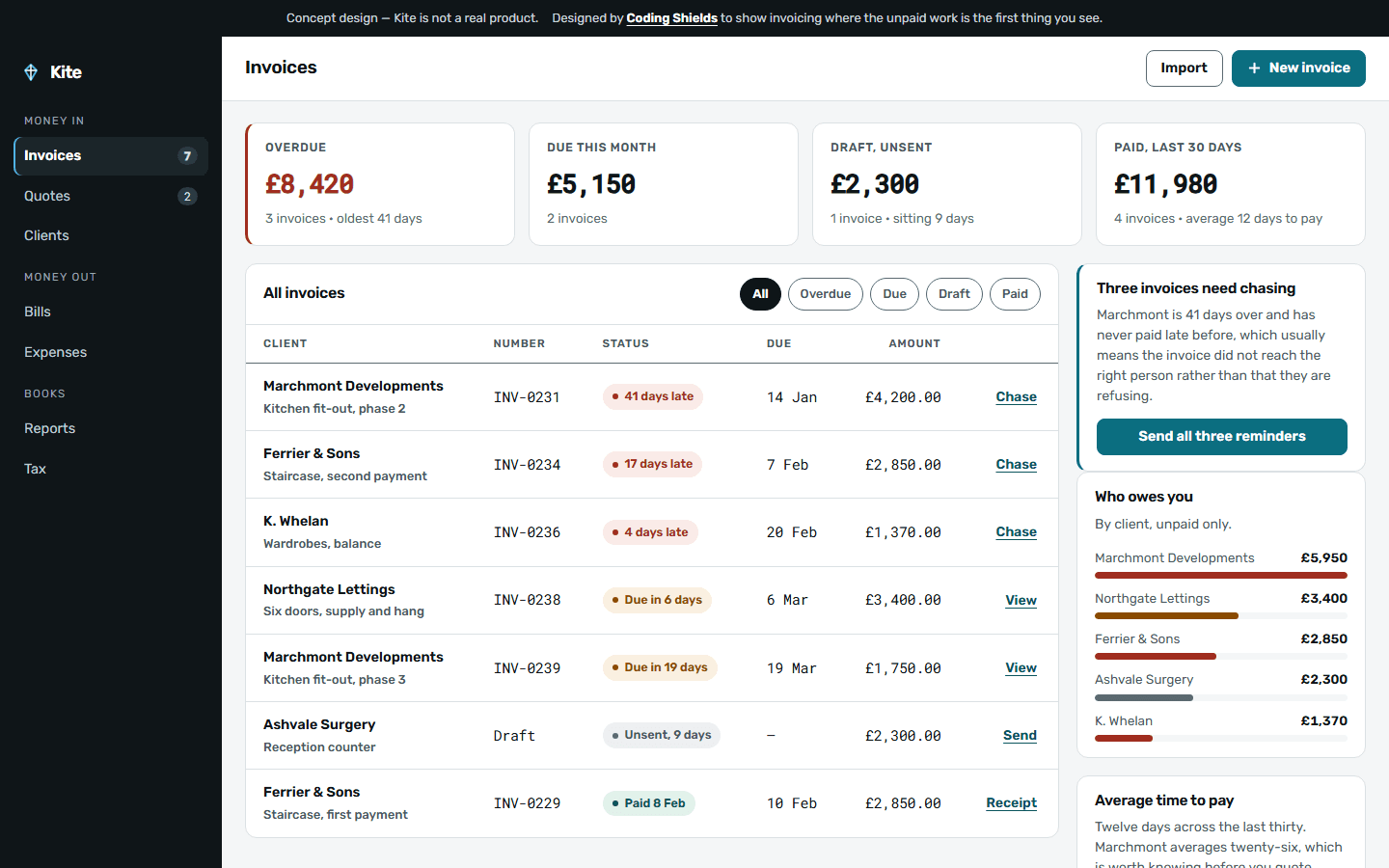
Overdue, due this month, drafted but unsent, and paid in the last thirty days. The overdue tile carries a red left border and the age of the oldest invoice.
The unsent tile is the one most tools omit. £2,300 sitting in drafts for nine days is money nobody is chasing because nobody has noticed — and it is entirely within the owner’s control, which makes it the most actionable number on the page.
The chase panel gives a reason, not a reminder
Beside the table: three invoices need chasing, and a note that Marchmont is 41 days over and has never paid late before, which usually means the invoice did not reach the right person rather than that they are refusing.
That sentence changes the email the owner writes. A prompt that only counts overdue invoices produces an accusatory chase; a prompt that interprets the pattern produces a useful one.
Who owes you, ranked
A bar list by client rather than by invoice, coloured by the worst status in each. Marchmont appears once with £5,950 across two invoices instead of twice with two numbers to add up.
Underneath, average time to pay — twelve days overall, twenty-six for Marchmont. That is the figure that should inform the next quote, and no invoicing tool surfaces it where a decision gets made.
Decisions
Four choices that shaped the page, each with the reason attached. A decision without a reason is a preference.
01
Overdue is defined with no grace period, and the page says why
An invoice is overdue the day after its due date. A grace period you have not agreed with the client is a delay you inflicted on yourself, and the footnote says exactly that.
02
Money is monospaced, everywhere
Every figure is tabular so columns of currency line up on the decimal. It is the smallest possible change and it is the difference between scanning a column and reading it.
03
Status chips carry the age, not just the state
“41 days late” rather than “Overdue”. The state is the same for every unpaid invoice; the age is what decides which one to chase first.
04
One primary action in the whole workspace
New invoice is the only filled button. Import, filters and per-row actions are all quieter, so the thing the business needs to do more of is the thing the eye lands on.
- Page weight
- 25KB of HTML, no images
- JavaScript
- One file: status filter and reminder drafts
- Typefaces
- Rubik, Roboto Mono
- Palette
- #0F1518 rail, #0B6E80 action
- Default view
- What is owed, not the ledger
- Contrast
- Nineteen pairs audited, AA or better
What this is not
- It is a concept. The business, the clients and every figure are invented.
- It is one screen of a product that would need at least ten — invoice creation, VAT returns, bank reconciliation and expenses are all stubbed as rail items.
- The chase panel interprets one pattern. Doing that properly needs real payment history per client, and getting it wrong is worse than not doing it at all.
Want one of these, for real?
Every page in this section started as a blank file. Yours would start as a conversation about what it actually has to do.