Insurance quote flow
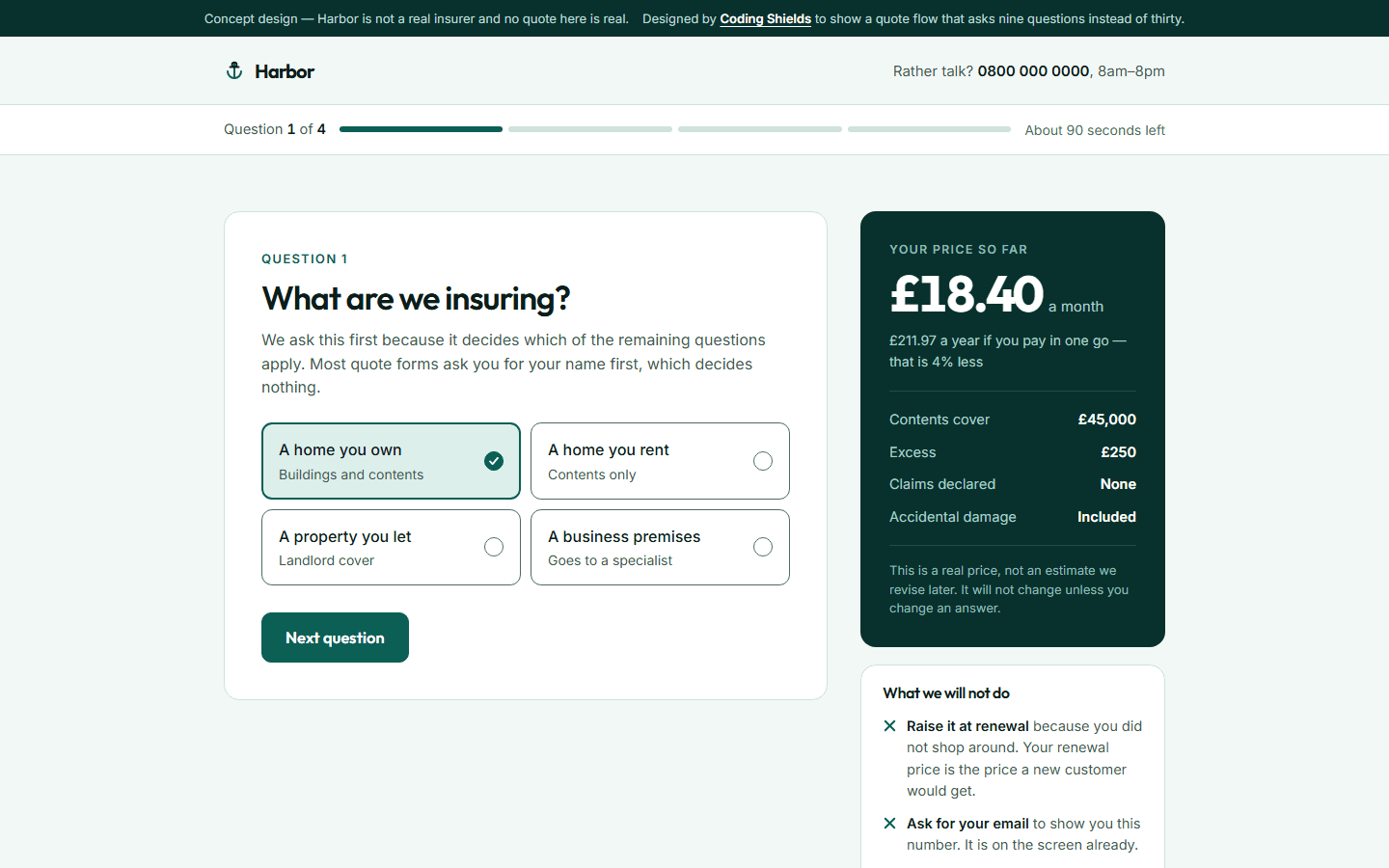
A home insurance quote flow that asks four questions and prices the answer as you go.
Opens in a new tab. It is a real page, not a picture of one — resize it, tab through it, run it through Lighthouse.
The brief
Self-directed. The rule: no question may be asked that does not change the price.
Insurance quote forms ask thirty questions to produce a number they then revise. Most of the thirty exist for underwriting rather than pricing, and asking them up front is a choice to spend the customer’s patience on the insurer’s convenience.
The brief was to sort the questions by whether they move the premium, ask only those, and show the price updating as each one is answered — so the customer can see which of their answers is expensive.
The price panel is present from question one
The running quote sits beside the form and is populated before the first answer, using defaults. It updates as the type of property, cover level, excess and claims history change.
Watching the number move is what teaches the customer the shape of the product. A £1,000 excess saving about nineteen percent is a fact you can feel by dragging, and no amount of explanatory copy delivers it as well.
Questions ordered by what they decide
The first question is what is being insured, because it determines which of the remaining questions apply. Most quote forms open with your name, which decides nothing at all.
Each screen also says why the question is being asked. The claims question carries a line saying one claim usually makes very little difference and that it is asked because it must be — which removes the sense of being judged.
Under-insurance, named as the real risk
The cover slider carries a note that under-insuring is the most common reason a claim gets reduced, and that the difference between £45,000 and £60,000 of cover is about £3 a month.
That advice is against the insurer’s short-term interest and in the customer’s. It is also the single most useful sentence on the page, and putting it next to the control is what makes it act on.
Decisions
Four choices that shaped the page, each with the reason attached. A decision without a reason is a preference.
01
Focus moves to the new question on each step
Advancing sends focus to the heading of the step that just appeared. Without it, a keyboard or screen reader user is left at the top of the document with no signal that anything changed.
02
The price is called a price, not an estimate
The panel says this is a real price that will not change unless an answer changes. An “estimated from” figure trains customers to expect the number to rise, which is why they distrust it.
03
A “what we will not do” panel beside the form
Three commitments: no loyalty penalty at renewal, no email required to see the number, no selling the data. The second is demonstrated by the page rather than promised — the price is already on screen.
04
Defaults chosen for the customer, not the insurer
The excess defaults to £250 rather than the highest option. A default is a recommendation, and defaulting to the cheapest premium at the customer’s expense is the oldest trick in the category.
- Page weight
- 24KB of HTML, no images
- JavaScript
- One file: steps and pricing
- Typefaces
- Outfit, Inter
- Palette
- #F2F8F6 ground, #0B5F55 action
- Questions
- Four, each one priced
- Contrast
- Fourteen pairs audited, AA or better
What this is not
- It is a concept. Harbor is not an insurer, the pricing model is a few multipliers, and no real quote could be produced without an address and an occupancy check.
- Four questions are shown of what would realistically be nine or ten. The argument is about ordering and feedback, not about the true minimum.
- There is no policy document, no payment step and no claims journey — which is where an insurance brand is actually judged.
Want one of these, for real?
Every page in this section started as a blank file. Yours would start as a conversation about what it actually has to do.